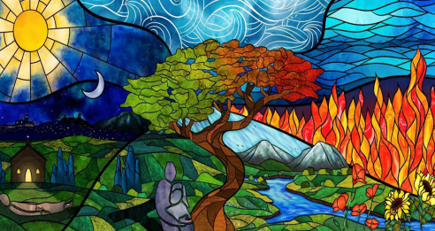
Earth Day 2012 Celebration at St. Camillus Church in Silver Spring, Md.

Surrounded by beautifully smelling white lilies, hydrangeas and azaleas at the foot of the altar, the parishioners would right away notice a large paining depicting the earth teaming with diverse creatures. Right above it, there was a sign with an important message written in many different languages: “God’s creation: handle it with care.”

This was the liturgical ambiance for the annual Earth Day celebration at St. Camillus Church (Silver Spring, Md.) that was prepared by the Latino members of the Justice, Peace and the Integrity of Creation committee. They worked hard to help ensure that the Sunday liturgies on April 22 would clearly reflect the theme of caring for God’s earth.

“We thought it was important that the music, offertory procession and prayers of the faithful that Sunday would allow our fellow parishioners to integrate the call to environmental justice with our Catholic faith,” said Ms. Perez, one of the members of the Latino JPIC.

There was something else that was done at Mass. When the people received the Communion, the church’s lights were turned off. Then, projected on the wall, right behind the altar, was an amazing video called “Creation Calls.” A number of parishioners, later on, commented on how much this unique Communion meditation meant for them: “It’s awesome that we could celebrating, here in the church, the ways God speaks to us in and through God’s creation. This is how I often experience God: out in nature as well as in the church,” said one young adult after the Mass.

He and close to 300 other members of St. Camillus parish stopped by the Earth Day table at the back of the church. There, they signed the Pledge of St. Francis to Care for God’s earth. They also received the information about ways they could live a more sustainable lifestyle. On a green paper in a shape of a human hand, they wrote their specific promises to care for the Earth. They were then attached to a paper, green tree.

Esther Reyes, a member of the Latino JPIC and of the Secular Franciscan Order, spoke glowingly about the event: “I and other members of JPIC committee, were amazed and filled with joy to see how well the entire community of St. Camillus responded to our Earth Day celebration. Our many different customs and languages spoken at the parish presented no barriers. The empty branches of the green, paper tree became by the end of the day completely filled with the parishioners’ written commitments to care for our Sister, Mother Earth.”

Sandra Perez who was also one of the main organizers of this parish-wide initiative said, “I was deeply moved by the positive responses we’ve received at the English-, Spanish- and French-speaking Masses. It was especially heartening to see the enthusiasm for the environment among the children and young people. This gives me a lot of hope.”

It’s worth noting that the Earth Day is by no means the only time that the Latino community at St. Camillus Church got involved in the issue of environmental justice. Recently, close to 50 members of the Latino community participated with great enthusiasm in a rally in front of the State Capitol in Annapolis, Md., to advocate in support of the Maryland Offshore Wind Energy initiative. (Watch a short video taken at that event.)

The members of the Latino JPIC committee are currently organizing a special musical concern entitled: “Celebrating God’s Creation: Defending the Life of Our Children.” The event is being sponsored and promoted by the local Hispanic radio station. “Last year, at a similar event, we had over 300 people participating. I know that this year, we’ll make it even better. We are working on this with the young people of the Archdiocese. As they learn about what is happening to our planet and about the close connection between our faith and the environment, they get fired up and ready for action,” said Otto Perez, who is a co-coordinator of the Latino JPIC committee and one of FAN’s commissioners.

Report by Otto Perez, Latino JPIC Committee, St. Camillus Parish, Silver Spring, Md.; FAN Action Commissioner

Published in: on May 21, 2012 at 6:00 am  Leave a Comment  

Care for Creation in Camden

By Alex Mancuso

After graduating from Siena College with a degree in environmental studies, I became a volunteer with the Franciscan Volunteer Ministry in Camden, N.J. Living the Franciscan tradition, I serve the poor at St. Anthony of Padua Parish. During my time here I have witnessed St. Anthony’s growing as an environmentally conscious parish. Through the Friends of Francis club that I created, students and parishioners have opportunities to learn more about the environment and become enthusiastic about protecting our precious earth. With a successful Earth Week at St. Anthony’s, the future of caring for creation looks bright!

Earth Week kicked off on Earth Day, which conveniently fell on a Sunday. The parish pastors, Fr. Jud and Fr. Hugh, each gave inspirational homilies about how important it is to care for God’s creation. The school choir, which consists of several 2nd and 3rd graders from St. Anthony of Padua School, sang “Brother Sun, Sister Moon.” Parishioners were invited to repeat each verse the children sang. The verses emphasized natural elements that St. Francis deeply appreciated. At the conclusion of the song, children from the congregation were selected to read a few compelling environmental facts aloud. Our parishioners were really captivated! It was nice to have planted a seed with them about environmental issues and ways they can make a difference.

During the week, students had the opportunity to participate in some fun “environmental activities.” Each day at dismissal students were introduced to a different theme. For example, one day each student was given a pot and filled it with soil to plant an herb seed of their choice. They were beyond thrilled that they could keep the pot and take it home. The theme of gardening was familiar to the children because many of their parents have a plot in Br. Jerry’s Community Garden across the street. Another day the students played a game in which they had to decide where the piece of garbage belonged. It could either go in the trash, be recycled, or be composted. By the end of the week the children were running up to the table at dismissal with anticipation of what we would do that day. Each day we had about 30-40 students visit our table and participate. The smiles on their faces were an indication that more events like this must take place at St. Anthony’s. The children are enthusiastic about caring for creation and want to learn more!

In addition to the daily activities for all students, Friends of Francis members were given a special opportunity to visit the Center for Environmental Transformation. Located in south Camden, the center leads various efforts towards raising environmental awareness. The greenhouse on the property serves as an excellent teaching tool to show children and adults how plants grow. They even grow native plants for rain gardens and vegetables to plant in community gardens. The kids were amazed that in such a small space so much can be accomplished. They even got to hold chickens, which was definitely their highlight. It was great to show the students that there are places in Camden to learn about sustainability and other community environmental issues.

The final piece to Earth week involved showing various environmental themed movies and invited all parishioners and students. The three movie nights shed light on the big picture of taking care of the earth, specific locations that contain species struggling to survive due to global climate change, and the dangers of mining in Bolivia. On the night with the most attendance, youth from St. Anthony’s teen confirmation class and young adults from our youth group watched Devil’s Miner. It was a story highlighting the struggles of two young Bolivian boys who work in a mine. What an incredible story! It really opened the eyes of our youth to struggles of children their age in other countries and the environmental impacts of mining.

How wonderful it was to witness the spreading of environmental knowledge among the Camden community. Earth Week provided the perfect setting for children to be inspired to care for the world around them. Many seeds were planted during the week and with the continuation of environmental activities, St. Anthony’s is sure to grow people who care for creation.

Published in: on May 18, 2012 at 10:00 am  Leave a Comment  

Neumann University Student Summit Addresses Environmental Issues

Brande Marshall, Neumann University Student

Neumann University student Brande Marshall.

Neumann University Student Brande Marshall describes a Student Government Summit focused on environmental issues:

The Neumann University Student Government Summit is an annual event at which members of the community, including students, faculty, and staff gather to discuss issues pertinent to the well-being of our campus and reflective of our Franciscan values. As the appointed student chair of this year’s summit, I decided the focus would be environmental issues. This was due in part to my experiences living on a Franciscan campus, and also the influence of our congregation of Sisters of Saint Francis of Philadelphia.

The research for this project began with numerous interviews with various faculty and staff, conducted over the course of three months. One of the earliest interview conducted was with Sr. Patricia Hutchison, OSF, Director of the Neumann Institute for Franciscan Studies. From Sr. Pat I received the document Sustainability and Catholic Higher Education: A Toolkit for Mission Integration, a resource of the Catholic Climate Covenant. This document served as the impetus for the entire summit, and set the tone for the rest of the preparation process. I also met with Dr. Elaine Grose who chairs the Care for Creation Committee and teaches Environmental Science at Neumann University.

From this document, our summit committee chose five actions that other universities had previously implemented and used these as fodder for group discussions at the March 27, 2012 Student Summit attended by approximately 100 students and 25 members of faculty, staff, and administration. The discussions focused on how these suggestions could be adapted and used at Neumann University. The discussions were fruitful and interesting, and led to ideas that will be used as the genesis for future initiatives at the University.

As this project is still a “work in progress,” there are still certain aspects that have yet to be fully realized. A key component of our work will be the actual changes enacted at the institution as recommended by the participants of the summit. The results of our summit discussion will be recorded and disseminated among the participants with the invitation to meet again and push for further discussion.

Published in: on April 24, 2012 at 12:30 pm  Leave a Comment  

With Christ in the Desert: Holy Week

During each week of Lent 2012, FAN featured images from a collage by Br. Jeffrey Wilson, TOR, entitled “Christ and the Steward of God’s Creation.”

This Holy Week, FAN unveils the full collage for your meditation and reflection. We invite you to share responses or insights.

To read Br. Jeff’s notes on each component of the collage, including portions which did not feature in FAN’s Lenten series, please visit the FAN website.

Published in: on April 1, 2012 at 6:00 am  Leave a Comment  

With Christ in the Desert: Fifth Week of Lent

During each week of Lent 2012, FAN features images from a collage by Br. Jeffrey Wilson, TOR.

Br. Jeffrey Wilson, TOR explains the symbolism of this portion of his collage.

Christ: The image of Christ is taken from Salvador Dalí’s painting, Christ of St. John of the Cross, which many consider to be the greatest religious painting of the 20th century. The crucified Christ hovers over the landscape, representing that Christ’s passion and death is the source of healing and reconciliation for the violence and division depicted in the scene below.

The original sin of Adam and Eve wounded the created order, both humanity and the rest of creation. Therefore, Christ’s salvation and restoration heals all creation, both humanity and the rest of creation. Through his death and resurrection, Jesus Christ recreates all things: “And the one who was seated on the throne said, ‘See, I am making all things new’” (Rev 21:5). “So if anyone is in Christ, there is a new creation: everything old has passed away; see, everything has become new!” (2 Cor 5:17). “For the creation waits with eager longing for the revealing of the children of God; for the creation was subjected to futility, not of its own will but by the will of the one who subjected it, in hope that the creation itself will be set free from its bondage to decay and will obtain the freedom of the glory of the children of God” (Rom 8:19-21).

Published in: on March 25, 2012 at 6:00 pm  Leave a Comment  

With Christ in the Desert: Fourth Week of Lent

During each week of Lent 2012, FAN features images from a collage by Br. Jeffrey Wilson, TOR.

Br. Jeffrey Wilson, TOR explains the symbolism of this portion of his collage.

Man and woman on the throne platform: The man sitting on the throne represents leaders in society: those in governments, businesses, and communities. He holds a posture of superiority and dominance. He believes that the two serpent armrests are at his service. However, he is actually a slave to them: “Very truly, I tell you, everyone who commits sin is a slave to sin” (Jn 8:34). His head is wrapped in a white cloth and he is holding his face in his left hand. The man’s mask represents confusion about his identity in relation to God and all that God has created, as expressed in an excerpt from the poem “All Clowns Are Masked and All Personae” (Delmore Schwartz): “Gifts and choices! All men are masked, and we are clowns who think to choose our faces.” In his right hand, the man holds an object representing the double helix of human DNA topped by an atom with the Earth as the nucleus. This object represents the human desire to control and manipulate every aspect of created order, from designer babies to the splitting of the atom. The man views the Earth and all of God’s creation, including himself, as his own possession and not as gifts of God.

The woman standing behind the man is an image of Diana Moore’s sculpture, “Figure of Justice,” and represents those who do not actively engage in exploitation, oppression, and violence but still benefit from these actions. She is tying a blindfold around her eyes to insulate herself from the truth around her. In many ways, she is like the rich man who ignored the needs of Lazarus (Lk 16:19-31). The Catechism of the Catholic Church explains, “Feigned ignorance and hardness of heart do not diminish, but rather increase, the voluntary character of sin” (1859).

Published in: on March 19, 2012 at 3:00 pm  Leave a Comment  

With Christ in the Desert: Third Week of Lent

During each week of Lent 2012, FAN features images from a collage by Br. Jeffrey Wilson, TOR.

Prophet and Lion, Br. Jeff Wilson, TOR

Br. Jeffrey Wilson, TOR explains the symbolism of this portion of his collage.

Prophet and the lion: On the right of the collage, a prophet and lion stand on a cliff and look out over the scene. The pairing of the prophet and the lion represents truth and justice and the proper relationship between humans and the rest of creation. “The lion has roared, who would not fear? The Lord GOD has spoken, who would not prophesy?” (Am 3:8). “Let justice descend, you heavens, like dew from above, like gentle rain let the clouds drop it down. Let the earth open and salvation bud forth; let righteousness spring up with them! I, the LORD, have created this” (Is 45:8). “I will listen for what God, the LORD, has to say; surely he will speak of peace to his people and to his faithful. Love and truth will meet; justice and peace will kiss. Truth will spring from the earth; justice will look down from heaven” (Ps 85:9, 11-12).

The prophet is an image of Walter Seymour Allward’s sculpture, Justicia. The prophet standing on the cliff is inspired by Gustave Doré’s engraving, The Prophet Amos. The Prophet Amos pronounces various crimes committed by the nations: “Because they threshed Gilead with sledges of iron (Am 1:3); Because they exiled an entire population (1:6); Because they […] did not remember their covenant of brotherhood (1:9); Because he pursued his brother with the sword, suppressing all pity, persisting in his anger, his wrath raging without end (1:11); Because they ripped open pregnant women (1:13); Because they hand over the just for silver, and the poor for a pair of sandals; They trample the heads of the destitute into the dust of the earth, and force the lowly out of the way” (2:6-7). The crucifix that the prophet is holding represents the “Christian lens” of the prophet, that is, the Christian perspective and understanding of proper stewardship and care for God’s creation. This perspective is Christocentric and is reflected in St. Paul’s Christ hymn: “He is the image of the invisible God, the firstborn of all creation; for in him all things in heaven and on earth were created, things visible and invisible [...] all things have been created through him and for him. He himself is before all things, and in him all things hold together” (Col 1:15-17).

The lion is an image of Sir Thomas Brock’s sculpture, Agriculture, at Queen Victoria Memorial, Buckingham Palace. The lion is inspired by several sources such as the lion being the king of the animal kingdom, the Lion of Justice, and the Lion of Judah. At first, it may appear that the lion is looking directly at the observer. However, upon closer observation, one discovers that the lion is actually looking over the observer’s shoulder. The prophet is looking over the violence of the scene while the lion is looking at the violence that is occurring back behind the observer in their society. The observer is invited to follow the lion’s gaze and examine the reality of one’s own situation. Concerning the relationship between humanity and the environment, Pope Benedict XVI explains, “This invites contemporary society to a serious review of its lifestyle, which, in many parts of the world, is prone to hedonism and consumerism, regardless of their harmful consequences. What is needed is an effective shift in mentality which can lead to the adoption of new lifestyles in which the quest for truth, beauty, goodness, and communion with others for the sake of common growth are the factors which determine consumer choices, savings, and investments” (Caritas in Veritate, 51).

Published in: on March 11, 2012 at 5:00 pm  Leave a Comment  

With Christ in the Desert: Second Week

During each week of Lent 2012, FAN features images from a collage by Br. Jeffrey Wilson, TOR.

Br. Jeffrey Wilson, TOR explains the symbolism of this portion of his collage. 

Throne: As Christ is the source of healing and reconciliation, the throne represents the source of division through domination over others, both humans and the rest of creation. The stone foundation disperses the weight of domination and oppression evenly among the humans on the left (humanity) and the elephant on the right (the rest of creation). Below the throne, a rift begins to open in the ground and spreads out towards the observer, growing wider as it goes. The rift represents the growing division and alienation between humanity and the rest of creation.

The two serpent armrests represent the direct opposites, or antitheses, to the great commandments given by Jesus. “The first is this, ‘You shall love the Lord your God with all your heart, and with all your soul, and with all your mind, and with all your strength.’ The second is this, ‘You shall love your neighbor as yourself.’ There is no other commandment greater than these” (Mk 12:29-31). The opposite of loving God with all one’s heart is idolatry. St. Paul equates idolatry to greed: “Put to death, therefore, whatever in you is earthly: fornication, impurity, passion, evil desire, and greed (which is idolatry)” (Col 3:5). “Be sure of this, that no fornicator or impure person, or one who is greedy (that is, an idolater), has any inheritance in the kingdom of Christ and of God” (Eph 5:5).

The serpent head on the man’s left hand side symbolizes greed/idolatry. Below the serpent’s head lie a stack of money and a bag that is tied tightly closed. While the money represents monetary greed, the cinched bag represents those things that we covet as our own, and thus, greedily desire above God. In other words, they are our idols.

The serpent head on the man’s right hand side symbolizes the opposite of loving one’s neighbor as oneself which are malice, violence, and unjust war. The right hand side is customarily a warrior’s weapon hand. Below the serpent’s head are a machine gun and a gurkha knife, tools that can be used for violence and war. “Simeon and Levi, brothers indeed, weapons of violence are their knives. Let not my person enter their council, or my honor be joined with their company; For in their fury they killed men, at their whim they maimed oxen. Cursed be their fury so fierce, and their rage so cruel!” (Gen 49:5-7).

The throne rests on two stone tiers, or platforms, that serve as the foundation. The front of the top tier is engraved with seven symbols representing the seven deadly sins while the bottom tier is engraved with eleven symbols representing various expressions of the seven deadly sins in today’s culture. The lower symbols are meant to help interpret the corresponding symbols above them, starting from the lower tier to the upper tier and on to the two serpent armrests.

Starting from the left of the image (“Not loving one’s neighbor as oneself”), the first symbol on the top tier represents “Wrath”; below it on the bottom tier appear symbols of a Wolfsangel, Sickle and Hammer, and Star. The next symbol on the top tier represents “Envy,” below which appear the Republican and Democrat party logos. Third comes “Lust,” illustrated in today’s culture by the Playboy Logo. In the middle of the throne, encompassing themes from both sides, features “Pride,” represented below by the BP Logo.

On the right side of the throne (“Not loving God with all one’s heart”), “Sloth” is closest to the center on the top tier, with the corresponding Ouroboros, an ancient symbol of a serpent eating its own tail, on the tier below. “Gluttony” appears above the McDonald’s Logo, followed finally by “Greed” with Euro, Yen, Pound, Shekel, and Dollar signs.

Published in: on March 2, 2012 at 5:27 pm  Leave a Comment  

With Christ in the Desert: First Week

During each week of Lent 2012, FAN features images from a collage by Br. Jeffrey Wilson, TOR.

Br. Jeffrey Wilson, TOR explains the symbolism of this portion of his collage.

City buildings: The city in the background is comprised of the largest buildings in the world. They represent unhealthy progress and development, that is, seeking progress for the sake of progress which is fueled by pride, consumerism, and the belief that bigger/more is better. In many ways, the city can be viewed as a modern day Tower of Babel. “Then they said, ‘Come, let us build ourselves a city and a tower with its top in the sky, and so make a name for ourselves’” (Gen 11:4). Pope Benedict XVI explains,

Openness to life is at the center of true development. […] The acceptance of life strengthens moral fiber and makes people capable of mutual help. By cultivating openness to life, wealthy peoples can better understand the needs of poor ones, they can avoid employing huge economic and intellectual resources to satisfy the selfish desires of their own citizens, and instead, they can promote virtuous action within the perspective of production that is morally sound and marked by solidarity, respecting the fundamental right to life of every people and every individual” (Caritas in Veritate, 28)

Published in: on February 26, 2012 at 2:21 pm  Leave a Comment  

With Christ in the Desert: Ash Wednesday

“The way humanity treats the environment influences the way it treats itself, and vice versa.”
– Pope Benedict XVI (Caritas in Veritate, 51)

“If you have men who will exclude any of God’s creatures from the shelter of compassion and pity, you will have men who will deal likewise with their fellow men.”
– Popularly attributed to St. Francis of Assisi.

During each week of Lent 2012, FAN features images from a collage by Br. Jeffrey Wilson, TOR.

Br. Jeffrey Wilson, TOR explains the symbolism of this portion of his collage.

Oil-covered lake: The oil-covered lake represents environmental pollution and is particularly inspired by the 2010 BP Deepwater Horizon explosion and Gulf of Mexico oil spill. Three oil-covered birds add to the environmental disaster scene. Instead of offering God the sweet aroma of the fruits of the Earth, a thick, black, toxic smoke rises into the heavens. “Awake, north wind! Come, south wind! Blow upon my garden that its perfumes may spread abroad. Let my lover come to his garden and eat its fruits of choicest yield” (Sg 4:16). “But thanks be to God, who in Christ always leads us in triumphal procession, and through us spreads in every place the fragrance that comes from knowing him. For we are the aroma of Christ to God among those who are being saved and among those who are perishing; to the one a fragrance from death to death, to the other a fragrance from life to life” (2 Cor 2:14-16).

Buffalo bones: The dead buffalo, or bison, adds to the scene of environmental violence. Many believe that, at one time, the buffalo represented the largest population of any wild land mammal on Earth. However, they almost became extinct in the 19th century do to over hunting. In fact, during the wars with the Native Americans, the U.S. Army encouraged the wholesale slaughter of the buffalo in order to deprive the Native Americans of their main food source. The violence against the buffalo represented violence against humans as well.

Published in: on February 20, 2012 at 6:00 am  Leave a Comment  
Follow

Get every new post delivered to your Inbox.

Join 63 other followers